I. How to Use
When to Use
Patients ≥ 18 years old presenting with concern for volume overload and venous congestion suspected to be due to cardiorenal syndrome. Often used daily to guide further diuresis.
Pearls / Pitfalls
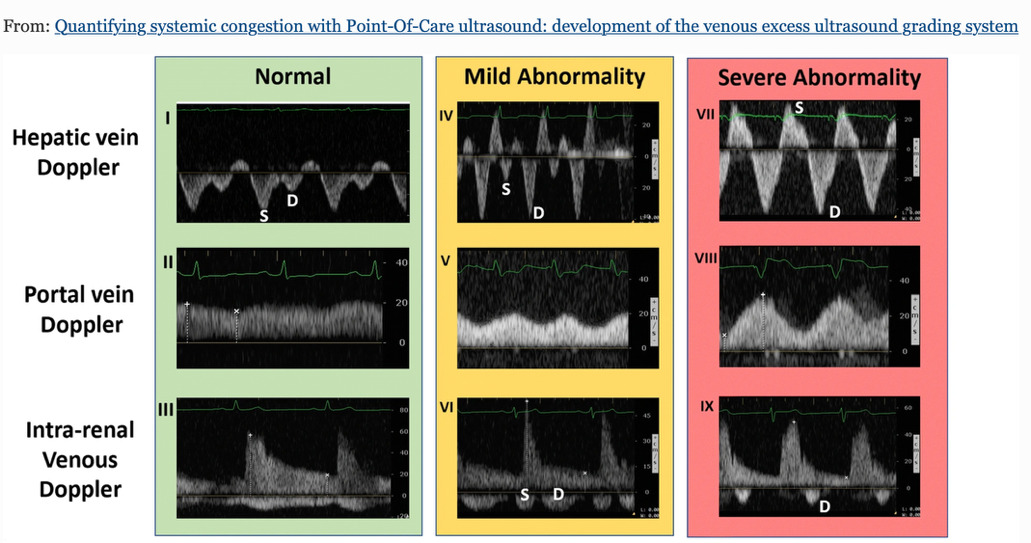
The VExUS score has not been studied or validated in patients in whom hepatic vein waveforms would be abnormal such as mechanical ventilation, ventricular assist device use, tricuspid regurgitation, severe pulmonary hypertension, or known right heart failure. Additionally, Interlobar renal vein waveforms may not be reliable in severe chronic kidney disease with eGFR < 15, renal transplant or those with cirrhosis and portal hypertension.
Performance of the ultrasound exam is best with an ECG monitor connected to the ultrasound to identify appropriate hepatic vein waveforms based on cardiac cycle. As with all ultrasound techniques, the data that may be obtained is highly operator dependent and requires formal training and standardization before a clinician should implement this exam. Regardless, there is about a 10-20% inability to complete rate despite training. Serial measurements of this score, often performed every 24-72 hours may inform whether additional decongestion via diuresis is needed.
Why to Use
Evaluation of patients with volume overload is often difficult and previous research has demonstrated that use of the IVC alone to guide fluid tolerance is unreliable. The VExUS exam allows for a quantitative assessment of venous congestion. Additionally, utilizing the VExUS score may support the diagnosis of a cardiac etiology for new onset AKI in patients with acute decompensated heart failure and suspicion for cardiorenal syndrome. Daily monitoring with the VExUS exam may help guide further decongestion with diuretic use during ICU admissions.
II. Next Steps
Advice
The VExUS score is one tool that may be utilized at the bedside to evaluate for venous congestion and may be incorporated into a patient’s overall clinical picture to guide diuresis or predict the development of postoperative AKI. Application of the VExUS score should only be done in patients who meet original study criteria and should not be utilized for those with tricuspid regurgitation, mechanical ventilation, and Ventricular Assist Devices or other mechanical heart support. It may have poor reliability in patients with chronic kidney disease with eGFR < 15 or renal transplant.
Management
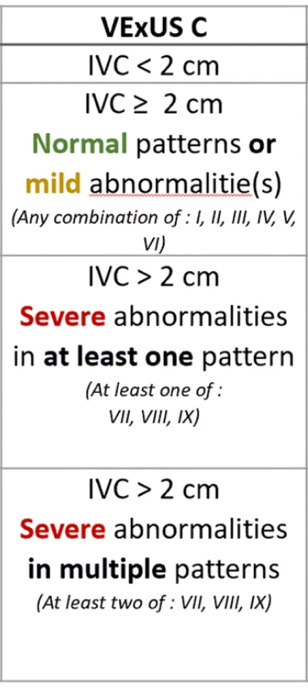
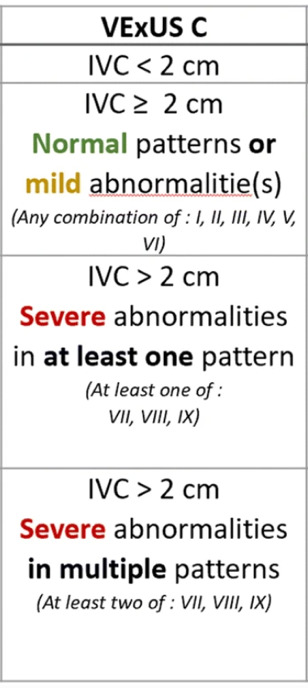
Consider diuresis for patients with a VExUS ≥ 2. Serial evaluations at 24–72-hour intervals may help guide further venous decongestion with greater accuracy than IVC measurements alone. It is important to note that patients with a VExUS of 0-1 may also receive benefit from diuresis and this should be guided based on the clinical context, physical exam, and laboratory evaluation.
Critical Actions
Patients presenting in extremis should not have life-saving therapies delayed to perform the VExUS exam.
III. Evidence
Evidence Appraisal
The initial development of the VExUS score from Beaubien-Souligny et al. was conducted in 145 patients who were undergoing cardiac surgery.1 The investigators excluded all patients with severe chronic kidney disease (eGFR < 15 mL/min/1.73m2), prior renal transplant, critical preoperative state, documented AKI prior to surgery, and any condition interfering with the doppler evaluation of the portal system such as cirrhosis or portal vein thrombosis. In post hoc analysis, a VExUS score ≥ 2 was associated with development of post-surgical AKI in this cohort and outperformed central venous pressure measurements with increased specificity.
These findings were subsequently validated in several studies, including those by Klompmaker et al., Utrilla-Alvarez et al., and Bhardwaj et al.2–4 Across these studies, a VExUS ≥ 2 was associated with development of AKI and suggested that serial assessments demonstrated that trends in the VExUS score could guide venous decongestion and track renal recovery. This was recently confirmed in a prospective study of critically ill heart failure patients where VExUS was found to be closely associated with right atiral pressure both pre-decongestion as well as after significant diuresis5 Notably, these investigations were done in patients with preexisting cardiac disease or high risk for cardiorenal syndrome. Collectively, they suggest that although higher VExUS scores are less prevalent, they effectively stratify the degree of venous congestion in this population.
In contrast, other studies in more heterogenous ICU populations have yielded less consistent results. Andrei et al. and Magin et al. found that in patients undergoing non-cardiac surgery or admitted to general ICUs, the VExUS score did not predict AKI or mortality.6,7 Other studies have correlated the elevated VExUS scores with increased right atrial pressures8 and with reduced diuretic efficiency.9 The lack of validation in these other populations may be due to the presence of multi-organ failure in the cohort of patients admitted to a general ICU which leads to a multifactorial etiology for the development of an AKI and mortality. It is reasonable that evaluation of venous congestion may not diagnose the etiology for AKI and that venous decongestion will not necessarily improve it. Further research is required to identify the best use of the VExUS scan in this population.
Two recent systematic reviews and meta-analyses have sought to further elucidate the role of VExUS in heart failure. The study by Chaves et al. reviewed 5 studies and found that lower VExUS scores were associated with improved hospital mortality with a mean odds ratio of 0.175.10 The other study performed by Carsetti et al. reviewed 8 studies and found that higher VExUS scores were associated with lower parameters of right ventricular function (such as tricuspid annular plane systolic excursion), but this was only present in patients with known heart failure.11 As such, it is reasonable that VExUS may continue to be used as a marker of systemic congestion rather than that of ventricular dysfunction.
Overall, these findings indicate that VExUS is most valuable in patients at risk for cardiorenal syndrome and prediction of AKI, though this may not extend to other critically ill patients in the general ICU. There is some evidence that VExUS scores may correlate with mortality in patients with heart failure. It is also important to remember that because most studies excluded patients with significant liver or advanced renal disease, the score should be applied with caution to these populations. To our knowledge, no impact analyses or clinical practice guidelines have incorporated VExUS into routine clinical assessment.
Formula
Facts & Figures